Best Blackout Curtains for Night Shift Workers: 4 That Actually Block the Sun
Disclosure: Some links in this article may earn us a commission at no cost to you. It keeps our testing budget alive during 3 a.m. research sessions.
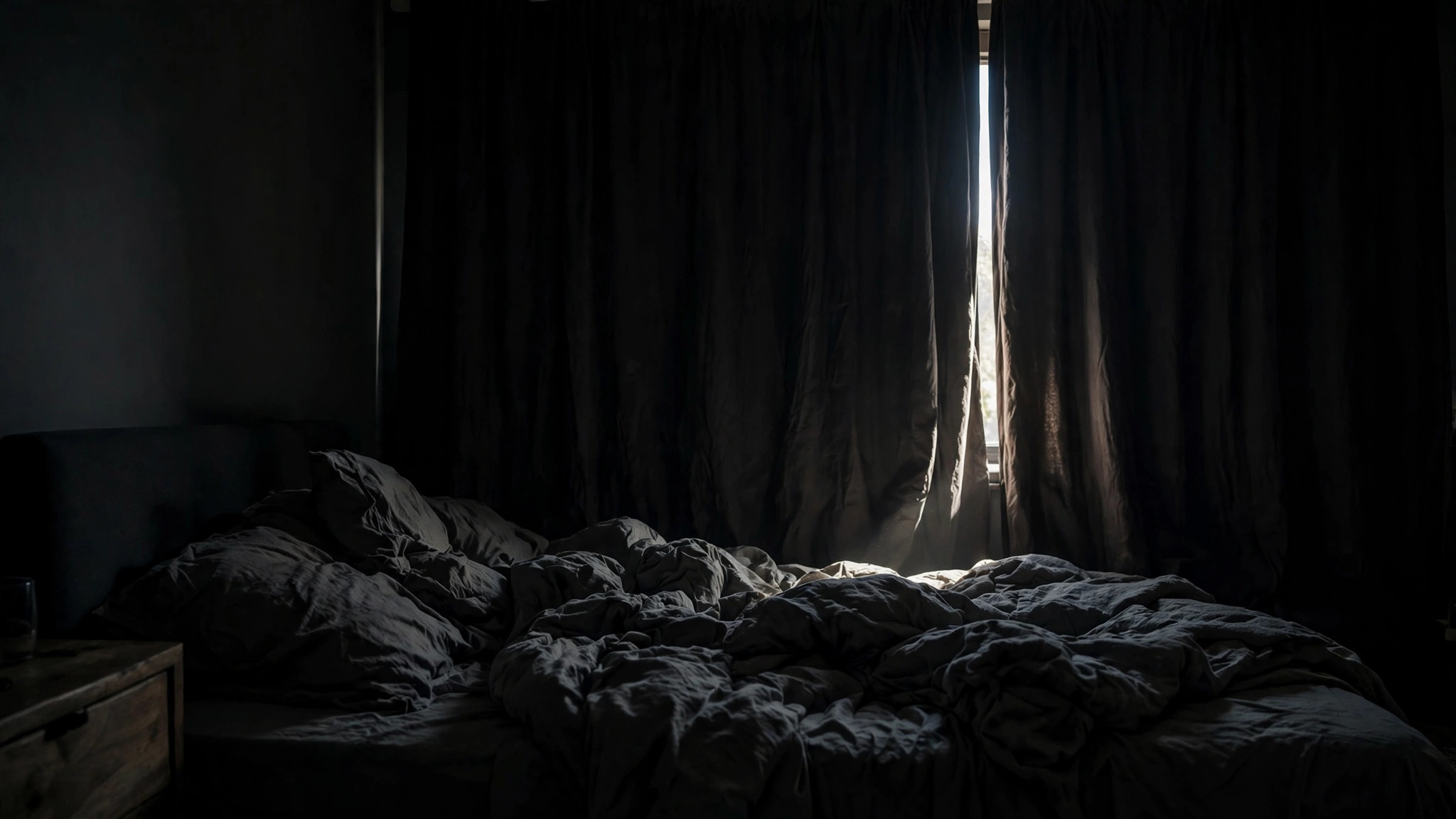
If you work nights, your bedroom at noon needs to feel like midnight. Not dim. Not moody. Dark enough that you can’t see your hand in front of your face.
That bar is higher than most curtain marketing admits. We’ve bought “blackout” curtains that were glorified sunglasses for windows, and woken at 1 p.m. with a stripe of sunlight across the pillow. This guide is the result of that expensive education.
Pair them with the rest of your setup — our full routine is in how to sleep during the day after night shift — and you’ve handled the biggest reason day sleep falls apart.
Why “room darkening” is a scam for day sleepers
Here’s the distinction the packaging hopes you never learn. “Room darkening” curtains typically block somewhere between 85% and 95% of light. True blackout curtains block 99–100%.
For someone sleeping at night, 90% is plenty. For you, crawling into bed at 8 a.m. while the sun climbs, that missing 10% is a bright gray glow filling the whole room. Even through closed eyelids, a bright room tells your brain it’s daytime, and sleep turns shallow and broken.
We see the same mistake over and over: a nurse or warehouse worker buys room-darkening panels, sleeps badly for a month, and concludes they “just can’t do day sleep.” Wrong conclusion. Wrong curtains.
Skip anything labeled room darkening or light filtering. You want fabric rated at true 100% blackout, ideally with a light-colored backing that reflects heat instead of absorbing it.
The 4 curtains we recommend
1. Sleepout Portable Blackout Curtain — best for renters and travel
The Sleepout is a single panel of certified 100% blackout fabric (roughly 52 x 78 inches) that mounts with industrial suction cups. No rod. No drilling. No landlord drama.
Setup takes about two minutes once you’ve done it twice, and the cups are the real deal — in our testing, a panel stayed up through three weeks of day sleep, including a stretch of 90-degree afternoons.
Because the fabric seals directly against the glass, edge leaks are smaller than with any rod-mounted curtain we’ve tried. It also packs into a bag for travel or crash-pad stays near the hospital.
The downsides are real. Around $109 for one window is steep, suction cups fail on textured or dirty glass (wipe the pane first), and when it’s up, the window is out of commission — no cracking it open for air.
2. NICETOWN Total Blackout Curtains — best value that actually works
NICETOWN’s Total Blackout line (make sure it’s the “Total Blackout” version, not their standard blackout) uses a coated backing that genuinely hits 100% in our flashlight test. A pair of 52 x 84 inch panels runs around $35.
We’ve run these in a west-facing bedroom — the hardest test there is, since afternoon sun hits the glass head-on during peak sleep hours. The room stayed properly dark, and the thick, stiff fabric hangs flat against the wall, leaking less at the edges.
One quirk: the coating can crack in a hot wash. Cold wash, hang dry, and air them out for a day first — they carry a factory smell out of the package.
3. Deconovo Blackout Curtains — best budget pick
Deconovo panels are the cheapest true-blackout option we’d still recommend, at around $26 for a pair. They use a triple-weave fabric rather than a coating, so they’re softer, wash better, and drape more like normal curtains.
Triple weave has a ceiling, though. Held against a bright window, the Deconovo fabric shows a faint deep-red glow at high noon where the coated NICETOWN shows nothing. In a real bedroom, hung a few inches off the glass, that difference mostly disappears. In a room where the bed sits right under the window, step up to a coated option.
For a spare room or a tight month, these are the ones we hand to people — just size up, because softer fabric needs extra width to seal the edges.
4. BGment Thermal Insulated Blackout Curtains — best for hot or cold rooms
BGment’s panels pair triple-weave blackout fabric with a thermal lining, around $30 for a pair. If your bedroom bakes in the afternoon sun or bleeds heat in winter, this is the pick.
Day sleepers forget the temperature half of the equation. Sun hammering a west window can push a bedroom 5–8 degrees warmer by mid-afternoon, and a warm room wrecks sleep as surely as a bright one does. We measured it with a cheap thermometer on the nightstand: the BGment room peaked noticeably lower.
They’re heavy, so use a sturdy rod with brackets screwed into studs if you can — a sagging rod means a light gap at the top.
Measuring: where most people get it wrong
Curtains that exactly match the window frame will leak. Every time.
- Width: buy panels totaling at least 1.5 to 2 times your rod width. Fabric that hangs in deep folds blocks the side gaps that flat fabric can’t.
- Length: extend 4–6 inches above the frame and let the panel fall to the floor or at least 4 inches below the sill.
- Sides: the panel should overlap the wall by 4–6 inches on each side of the frame.
We write the numbers on painter’s tape stuck to the wall. Fussy, but it beats a second return shipment.
Fixing light leaks (the halo problem)
Even perfect fabric leaks at the edges. Light bounces around the gap between curtain and wall and paints a glowing outline — the halo — around your window.
Three fixes, cheapest first:
- Mount the rod close to the wall. Standard brackets hold curtains 3–4 inches off the wall. Swap to wraparound (return) rods or mount brackets so the fabric sits 1–2 inches out. Less gap, less bounce.
- Velcro strips. Adhesive hook-and-loop strips along the frame and curtain edge seal the sides completely — the highest-impact fix we know, about $8 in materials.
- A top valance or a rolled towel. The gap above the rod leaks more than people expect; a valance — or a dark towel over the rod — kills it.
Do the flashlight test when you finish: lights off at midday, eyes adjusted for five minutes, then look for the leaks.
Comparison table
| Product | Type | Approx. price | Best for |
|---|---|---|---|
| Sleepout Portable Blackout Curtain | Suction-cup portable panel | Around $109 | Renters, travel, zero-drill installs |
| NICETOWN Total Blackout | Coated rod-pocket/grommet panels | Around $35/pair | Best all-around value |
| Deconovo Blackout | Triple-weave panels | Around $26/pair | Tight budgets, spare rooms |
| BGment Thermal Insulated | Thermal-lined triple-weave panels | Around $30/pair | Rooms that overheat or run cold |
Our honest caveat
We’ve tested these in apartments and one very sunny rental house, over weeks rather than years. Coated fabrics can degrade faster in brutal all-day sun than triple-weave, and we honestly don’t know yet how the Sleepout’s cups hold up after two summers of heat cycles. If your window takes extreme sun, triple-weave is the safer long-term bet.
Bottom line
Curtains handle the light. They can’t handle the neighbor’s lawn crew or a doorbell at noon — that’s a sound problem, and we cover it in our guide to the best white noise machine for shift workers.
Start with the NICETOWN Total Blackout if you can drill and want the best darkness per dollar. Go Sleepout if you’re renting or splitting time between two places. Whichever you pick, seal the edges with Velcro and run the flashlight test before your first shift. Darkness is a system, not a product.