Portable Blackout Blinds for Renters on Night Shift: No Drilling, Real Darkness
Disclosure: Some links in this article may earn us a commission at no cost to you. It keeps our testing budget alive during 3 a.m. research sessions.
Portable blackout blinds for renters are the fastest way to get real daytime darkness without drilling a single hole. The best options stick, suction, or velcro straight onto the window, come down when you move out, and leave nothing behind for a landlord to complain about. If your lease bans curtain rods, this is your answer — not thinner curtains, and definitely not a towel over the window.
I tested portable options for two weeks on a 7-to-7 roster in a rented apartment with a west-facing bedroom window, the worst possible combination. One option gave me genuine midnight darkness at noon. One fell off the glass on day three. One worked but made the room feel like a sealed box. Here is the honest breakdown.
Why portable blackout blinds beat regular curtains for renters
A rod-mounted curtain leaks light at the sides, the top, and anywhere the fabric does not sit flat against the wall. A portable blind seals directly against the glass, so the halo of light around the edges shrinks to almost nothing. That matters more than the fabric itself. I have slept behind expensive curtains that leaked a bright frame of daylight all afternoon, and behind a cheap suction-cup panel that kept the room properly dark.
The renter angle is just as important. Most leases forbid drilling into window frames, and even where drilling is allowed, nobody wants to patch and repaint a wall on moving day. Portable blinds sidestep the whole problem. You put them up in minutes, take them down in seconds, and pack them in a bag for the next place.
The science backs the darkness-first approach. CDC guidance for night shift workers says the sleep environment should be so dark you cannot see your hand in front of your eyes, and that daylight will trigger waking even through closed eyelids — see the CDC’s guidance on coping with night and evening shifts. A separate CDC review notes that night shift workers usually get less sleep overall than day workers, and poorer-quality sleep, which is why protecting every hour of day sleep matters so much. In one NIOSH study of night shift workers, subjects averaged only about 6.5 hours of daytime sleep — so a blind that buys you an extra unbroken hour is not a luxury, it is the whole game.
The 3 types of portable blackout blinds, compared
1. Suction-cup panels — best overall for renters
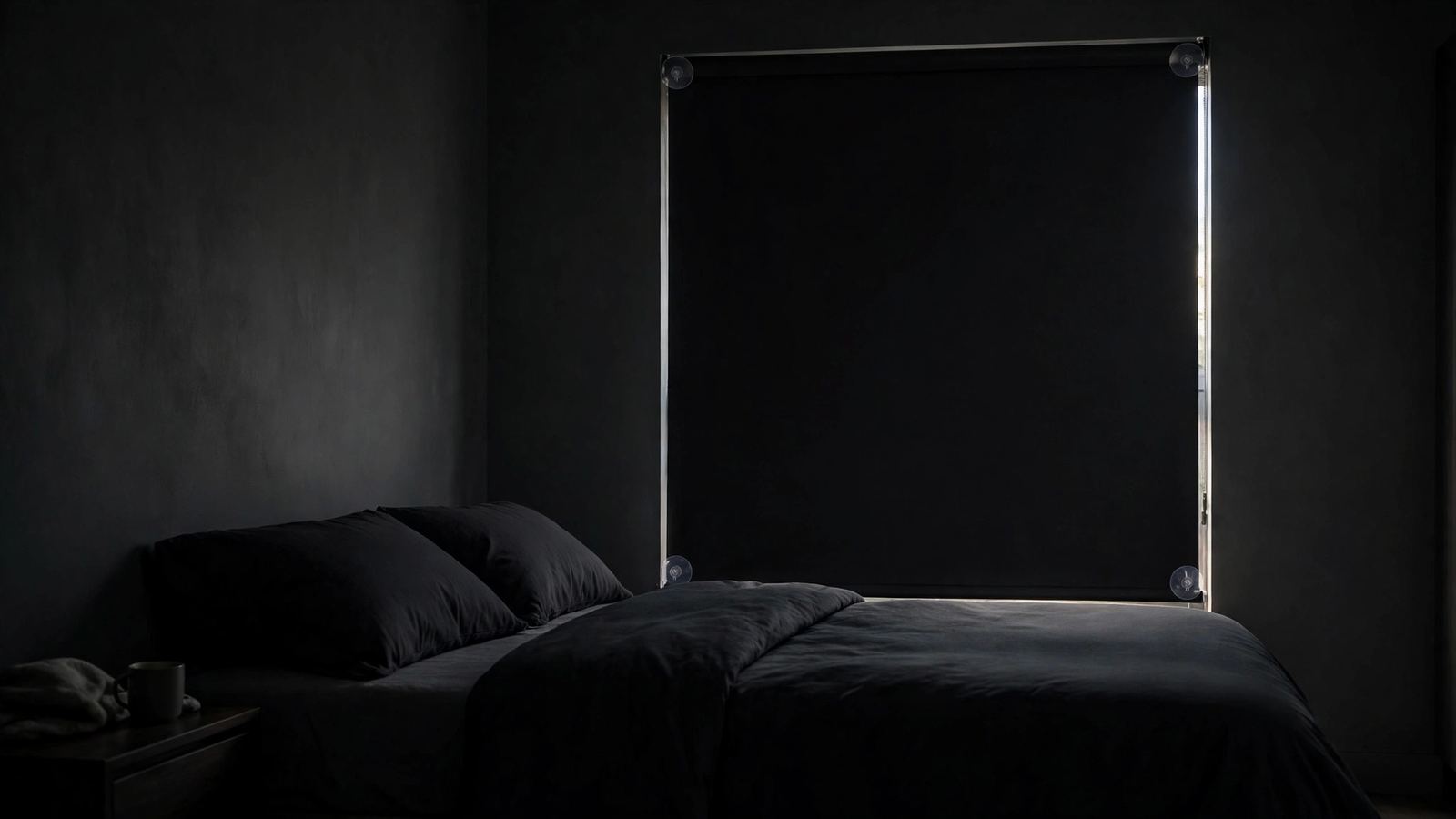
A suction-cup panel is a single sheet of blackout fabric with heavy-duty cups sewn or clipped at the corners. You press it onto clean glass, smooth out the air, and it stays. The Sleepout panel, which we also covered in our guide to the best blackout curtains for night shift workers, runs around $109 for one window. Budget versions like the Amazon Basics suction-cup shade cost far less and work on the same principle.
In my two-week test, a suction-cup panel was the only option that survived a full stretch of hot afternoons without sagging. The seal against the glass is what does it — there is nowhere for light to sneak around. Setup takes about two minutes once you have done it twice.
The weak point is the glass itself. Cups grip smooth, clean glass and fail on textured, frosted, or dirty panes. Wipe the window with a damp cloth first, press each cup firmly, and check them after the first hot day. If a cup pops at 2 p.m., you will know about it fast.
2. Cut-to-fit velcro sheets — best for odd windows and tight budgets
These are rolls or sheets of blackout fabric you trim to your exact window shape, then stick up with adhesive velcro strips around the frame. Kits run roughly $24 and cover a standard window, and they handle arched tops, small bathroom windows, and sliding panes that no ready-made panel fits.
The custom fit is the real selling point. Cut the sheet slightly oversized and the edges overlap the frame, which kills the side leaks that ruin most setups. I used one on a narrow kitchen-adjacent window that no panel would cover, and it was the darkest that window has ever been.
Two honest drawbacks. First, the adhesive velcro can leave residue on painted frames if you rip it off in a hurry — peel slowly and keep the strips on the glass, not the paint, where you can. Second, trimming takes patience. Measure twice, cut once, and leave the sheet a finger-width larger than the frame on every side.
3. Stick-on adhesive shades — best for a semi-permanent fix
Stick-on shades are pleated or flat blackout sheets with an adhesive backing that presses directly onto the glass. They look the neatest of the three, sit almost flush, and cost little. For a rental you plan to stay in for a year or more, they are a solid pick.
The catch is right there in the name: they stick. Removal takes a scraper, warm soapy water, and patience, and on older windows the adhesive can be stubborn. They are also single-window, single-shape — you cannot move one to a new apartment the way you can fold up a suction-cup panel. Think of these as portable in the sense that they need no tools, not in the sense that they travel with you.
Comparison table
| Type | Approx. price | Best for | Watch out for |
|---|---|---|---|
| Suction-cup panel | Around $25–$109 | Renters, travel, most windows | Cups fail on textured or dirty glass |
| Cut-to-fit velcro sheet | Around $24 | Odd shapes, tight budgets | Adhesive residue if rushed off; needs careful measuring |
| Stick-on adhesive shade | Around $15–$30 | Longer stays, neat look | Harder to remove; does not move with you |
How to install one without wrecking your deposit
Clean the glass first. Dust and grease are the number one reason suction cups and adhesive strips fail, and a thirty-second wipe fixes both. Measure the window, then buy or cut slightly larger than the frame — coverage that overlaps the edges beats a perfect-fit panel that leaves a glowing border.
For suction cups, press the center of each cup, not the edge, and give it a firm hold for a few seconds. For velcro sheets, stick the frame side of the strips to the glass itself where possible; glass cleans up with a razor scraper and leaves no paint damage. Run the flashlight test at midday when you finish: lights off, eyes adjusted for five minutes, and look for leaks. A sliver at one corner is normal on the first try — shift the panel a few millimeters and retest.
Pair the blind with the rest of the room. Darkness handles the light, not the neighbor’s lawn crew or a doorbell at noon. Our guide to the best white noise machine for shift workers covers the sound half, and a contoured mask covers any leak you cannot fix today — see our picks for the best sleep mask for night shift workers.
Our honest caveat
I tested these in one apartment over two weeks, not across years of moves and seasons. Suction cups that held through one summer may weaken after repeated heat cycles, and adhesive that peels cleanly off new paint may fight you on a twenty-year-old frame. If your window gets brutal all-day sun, check the cups weekly for the first month. And no portable blind fixes a room that is also hot, noisy, and full of phone notifications — darkness is one part of a system, not the whole system.
Bottom line
If you rent and work nights, start with a suction-cup panel. It is the only option that is genuinely portable, genuinely dark, and genuinely deposit-safe on day one. Go cut-to-fit velcro if your windows are odd shapes or your budget is tight, and pick stick-on shades only if you are staying put for a while. Whichever you choose, seal the edges, run the flashlight test, and protect the sleep you have — a CDC review found night shift workers already lose sleep to daylight, and a blind that holds the dark is the cheapest hour of sleep you will ever buy.
FAQ
Do portable blackout blinds really block 100% of light?
The fabric itself can, but the edges decide the result. A panel sealed flat against the glass with suction cups or velcro blocks nearly everything; a panel that is too small leaves a glowing frame. Buy or cut slightly larger than the window and check with the flashlight test at midday.
Will suction cups damage my rental windows?
No, when used on smooth glass. Suction cups leave no marks and need no holes. They struggle on textured or frosted glass, so test one cup for a day before committing to a full panel on an unusual window.
Can I take portable blackout blinds with me when I move?
Suction-cup panels and velcro sheets, yes — fold them up and pack them. Stick-on adhesive shades are the exception; they are hard to remove cleanly and are best treated as a one-apartment fix.
Are portable blinds better than blackout curtains for night shift sleep?
For renters, usually yes, because the seal against the glass beats a rod-mounted curtain’s edge leaks, and nothing needs drilling. If you own your place and can mount a wraparound rod, a good coated curtain can match them — our curtain guide compares the best of those.
This article shares general wellness information, not medical advice. If you have a sleep disorder, persistent insomnia, or a health condition affected by shift work, talk to a qualified healthcare professional.