Blackout Curtains vs Sleep Mask for Day Sleeping: Which Is Better?
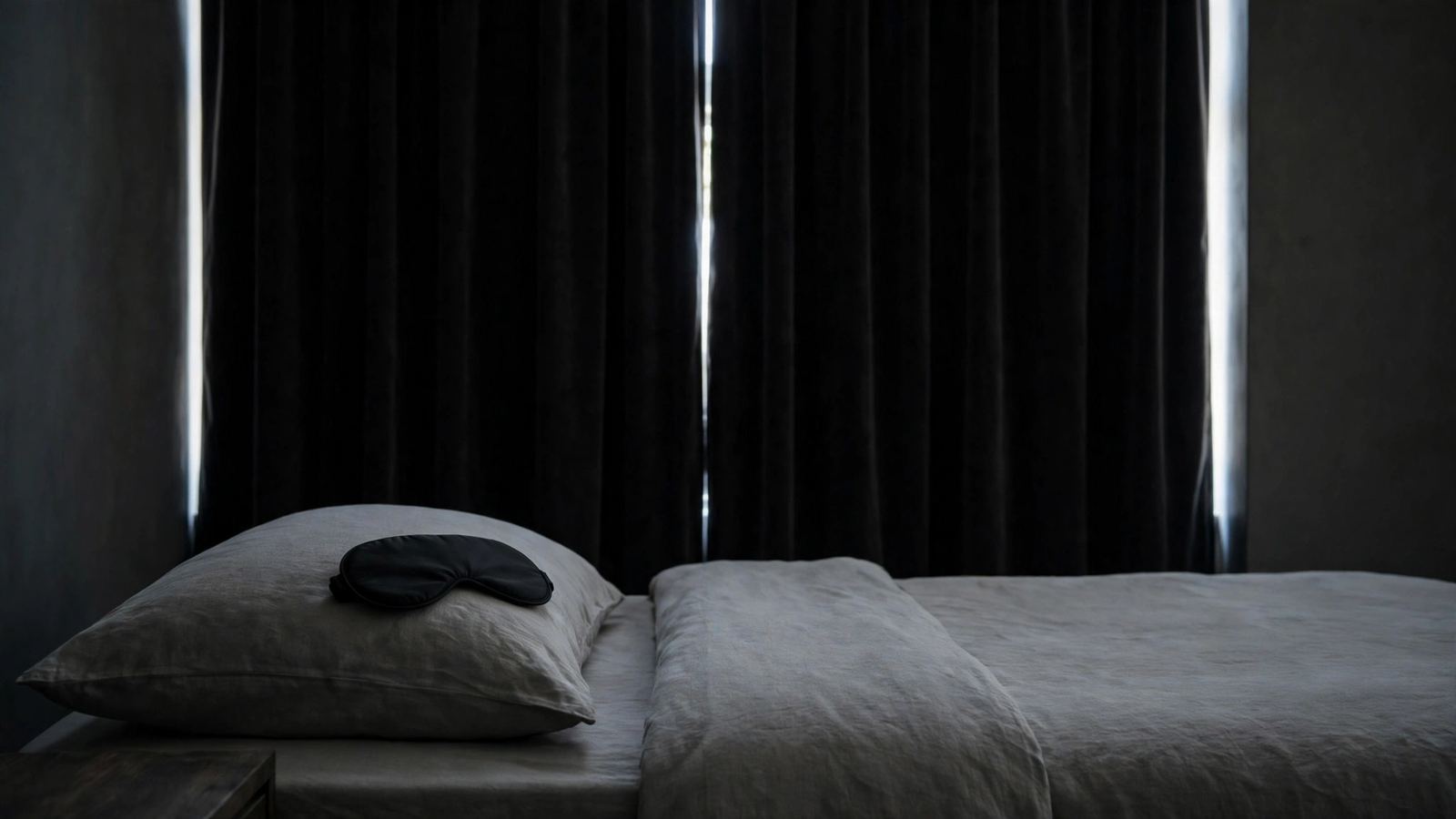
Blackout curtains vs sleep mask — if you can only buy one for day sleeping after night shift, buy the sleep mask first. It costs under $20, it works tonight in any room, and it blocks light at the only place that matters: your eyes. Curtains are the better long-term investment for a bedroom you own, but they leak light at the edges, they take an afternoon to hang properly, and they do nothing for you the night you sleep somewhere else. I spent two years on a 7-to-7 hospital roster with both, and the mask is the one I reached for every single shift.
Disclosure: Some links in this article may earn us a commission at no cost to you. Both options below were bought with our own money and slept under on real night shifts before they earned a word of this review.
Blackout curtains vs sleep mask: the short answer
Curtains win on room-wide darkness, temperature, and noise. A mask wins on price, portability, and total darkness at the eye. For most shift workers the honest answer is both, used together — curtains kill the big daylight, the mask kills the leaks. But if your budget forces a choice, the mask wins because it works in every room you will ever sleep in, including the ones you cannot modify.
How blackout curtains actually perform
Good curtains block a lot of light. A lined, floor-length set in a dark fabric cuts a sun-blasted room down to a dim cave, and that is a genuine transformation if you have ever tried to sleep at 10 a.m. in a white-walled rental. They also do two things a mask never will: they insulate the window, so the room stays cooler in summer, and heavy fabric takes a small edge off street noise.
The problems show up in the details. Light sneaks around the sides, over the top, and under the hem unless you mount the rod wide and high and add side channels or a valance. My first set looked blackout in the product photos and leaked like a sieve at 1 p.m. because the rod was exactly window-width. Fixing it meant a wider rod, longer panels, and adhesive side strips — another $30 and another trip to the hardware store.
Curtains are also fixed to one room. They do not travel to a crash pad, a partner’s flat, or a hotel on a work trip. They need a rod, a drill or at least a tension mount, and a landlord who does not object. And a full set for one window runs $60 to $150 once you count the rod and hardware, versus $10 to $40 for a mask.
If you want the full curtain breakdown — fabrics, linings, and the mounting mistakes that cause leaks — read our guide to the best blackout curtains for night shift workers.
How a sleep mask actually performs
A contoured mask with deep eye cups gives you near-total darkness the second you put it on, in any room, at any brightness. That is its whole superpower. I have slept in a sunlit hotel room at noon with a mask on and woken up thinking it was 3 a.m. No curtain I have owned has ever delivered that level of darkness at the eye, because curtains fight the whole room and a mask only has to cover two eyes.
Fit is everything, and this is where cheap masks fail. A flat silk mask presses on your eyelids, slides off when you roll over, and lets a stripe of light in at the nose. A contoured foam mask with an adjustable strap stays put and leaves your eyes free to move during REM sleep. Spend the extra $5. The difference between a $7 flat mask and a $15 contoured one is the difference between a gadget you abandon in a drawer and one you use 300 nights a year.
The downsides are real. Some people hate anything touching their face while they sleep, and no review can talk you out of that — you either tolerate it after three or four nights or you do not. Masks get warm in summer, they pick up face oil and sweat fast, and the elastic wears out in six to twelve months.
For the full head-to-head of mask types, see our guide to the best sleep mask for night shift workers.
Side-by-side: curtains vs mask
| Blackout curtains | Sleep mask | |
|---|---|---|
| Light blocked | 95–100% of window light, but leaks at edges | 99–100% at the eye, if the fit is right |
| Cost | $60–$150 per window with hardware | $10–$40 |
| Setup | Rod, drilling, an afternoon | Five seconds, no tools |
| Portability | Zero — fixed to one room | Fits in a pocket, works anywhere |
| Room temperature | Cools the room, insulates | Can trap heat on the face in summer |
| Noise | Slight reduction from heavy fabric | None at all |
| Lifespan | 3–5 years | 6–12 months before the elastic gives up |
| Partner-friendly | Only if both of you want darkness | Perfect when your schedules clash |
Why total darkness is worth arguing about
This is not a comfort preference. Light during sleep changes what your body does overnight. In a 2022 Northwestern University study published in PNAS, 20 healthy young adults slept one night in dim light under 3 lux and another night in moderate room light of 100 lux. After the lit night, their nighttime heart rate was higher, their heart rate variability dropped, and their next-morning insulin resistance rose. One night was enough to move all three numbers.
The same study is a warning against half-measures: the researchers note that only an estimated 5 to 9% of light is transmitted through closed eyelids to the eyes. That sounds small until you realise a sunlit bedroom at noon is thousands of lux — 5% of a lot is still a lot. A curtain that blocks 95% of a blazing window can still leave enough light leaking around the edges to matter. A mask that sits flush on your face has no edges to leak through.
The CDC’s own shift-work guidance backs the same standard: its NIOSH training for nurses on shift work says your sleep environment should be very dark, so dark you cannot see your hand in front of your eyes, and it lists blackout shades and an eye mask side by side as the two ways to get there. Darkness is not a luxury add-on for day sleep. It is the baseline.
Who should buy which
Buy the mask first if: you rent, you travel for work, you sleep in more than one place, your partner keeps different hours, or you want darkness tonight for $15. This is most shift workers in their first two years on nights.
Buy curtains first if: you own your bedroom, you sleep in the same room every shift, you run hot in summer and want the insulation, or you genuinely cannot stand anything on your face. No shame in that last one — a mask you rip off at 11 a.m. blocks zero light.
Buy both if: you can afford it. This is the setup I run now and the one I recommend without hesitation to anyone settled in one place. Curtains handle the window, the mask handles the gaps, the door light, and the phone charger LED you forgot about. Together they are the closest thing to a night shift cave you can build in a day-lit house.
Hot sleepers, one warning: a heavy mask plus a warm room is a miserable combination. If your bedroom runs warm, pair a lightweight contoured mask with curtains rather than a thick padded one, and sort the room temperature first — our guide to how to set up your bedroom for daytime sleep covers the cooling side properly.
My pick, and the honest caveat
My pick is the mask first, curtains second, both eventually. That order has survived every roster I have worked, because the mask is the only option that never depends on your landlord, your room, or your budget that month. A $15 contoured mask plus a $10 roll of blackout film on the window beats a $150 curtain set with leaky edges.
Here is the caveat, and it matters: neither option fixes noise, and noise is what wakes most day sleepers after light is handled. A mask blocks light and nothing else. Curtains muffle a little traffic and nothing else. If your street is loud, or your household is up at noon, you still need earplugs or a white noise machine — darkness alone will not carry a full day sleep. Do not buy either product expecting it to solve the whole problem. Buy it to solve the light problem completely, then solve noise separately.
FAQ
Do blackout curtains block 100% of light?
No — not in a real room. The fabric itself can block close to 100%, but light leaks around the sides, top, and bottom of the panel unless you mount the rod wider than the window and seal the edges. A well-installed set gets you to a very dark room; a mask gets you to total darkness at the eye.
Is a sleep mask better than blackout curtains for shift workers?
For most shift workers, yes, as a first purchase. A mask is cheaper, portable, and works in any room, including rentals and hotels where curtains are not an option. Curtains are better as a permanent bedroom upgrade, and the two together beat either one alone.
Can I use a sleep mask and blackout curtains together?
Yes, and you should if you can. Curtains cut the room’s overall light level and keep the room cooler, while the mask blocks the remaining leaks around the curtain edges, under the door, and from electronics. This combination is the standard setup for experienced night shift workers.
Will a sleep mask damage my eyes or eyelashes?
A flat mask that presses on your eyelids can irritate eyes and, over time, bother eyelashes. A contoured mask with deep eye cups avoids this because the cups sit around the eyes without touching them. If you wake up with sore or dry eyes, the mask’s fit is the problem, not masks in general.
This article is general wellness information, not medical advice. If you have a sleep disorder or persistent daytime sleepiness that affects your safety at work, talk to a healthcare professional.