How to Set Up Your Bedroom for Daytime Sleep: The Full Night-Shift Bunker
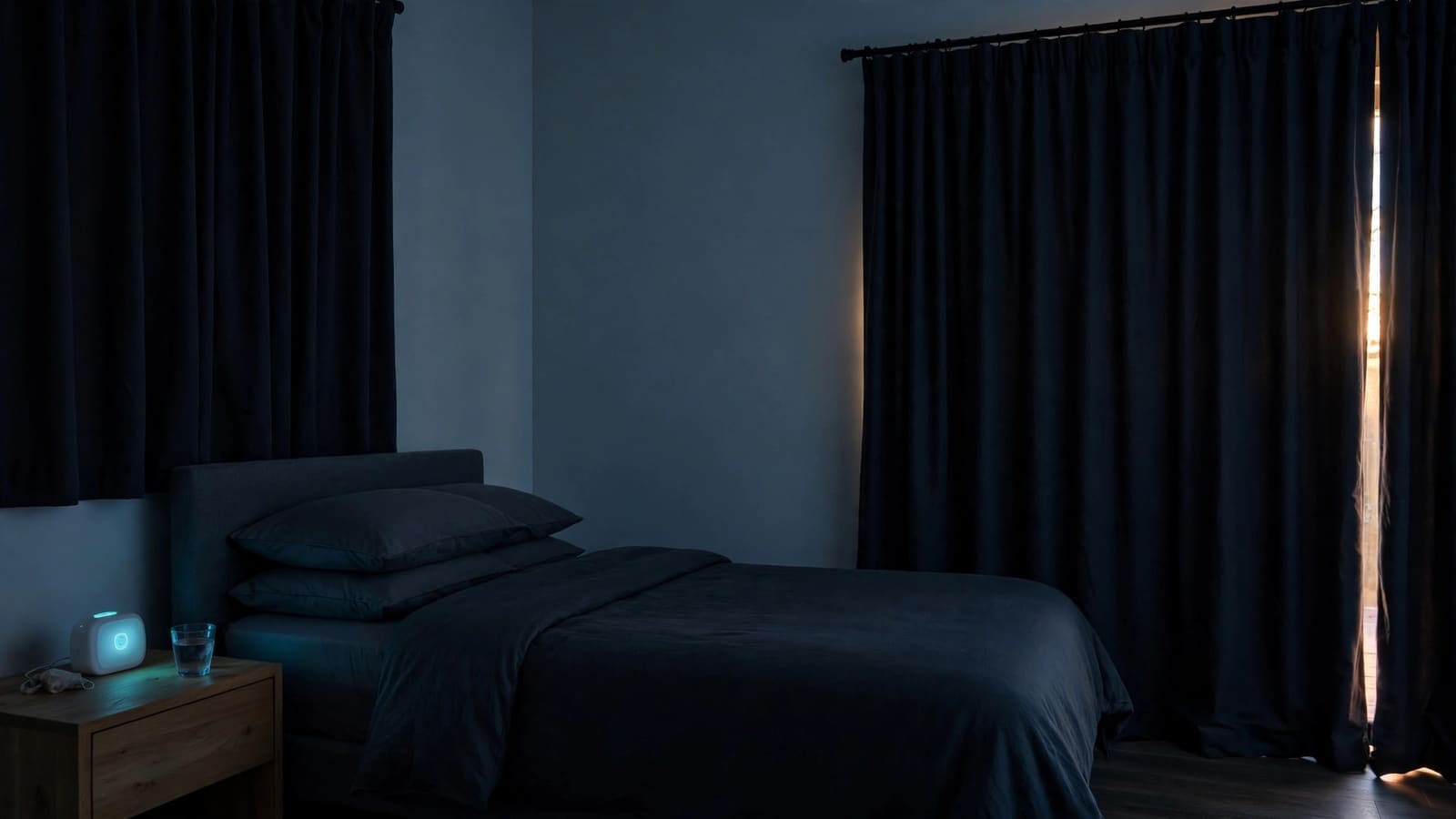
Your bedroom was designed by people who sleep at night. Every default choice in it — the thin curtains the landlord hung, the blinds that leak light at the edges, the thermostat schedule that lets the room bake at 2 p.m., the phone charging six inches from your pillow — assumes you sleep when it’s dark and quiet outside.
I slept in bedrooms like that for my first two years on nights, and I was tired in a way coffee couldn’t touch. Then I rebuilt my room around one question: what would this room look like if midnight happened at 9 a.m.? That rebuild — not a better pillow, not a supplement — was the single biggest jump in my sleep quality I ever measured.
Here is the full setup, in the order that matters.
Light: blackout is not a curtain, it’s a system
Start with the windows, because light is the strongest signal your brain gets about what time it is. A bedroom that leaks daylight at noon will keep your melatonin suppressed all afternoon, no matter how exhausted you are.
My position is firm here: curtains first, mask as backup. A sleep mask is brilliant insurance — we sleep-tested four of them and picked a clear winner — but it’s a patch, not a foundation. Curtains can’t fall off at 1 p.m. when you roll over. They also darken the whole room, so the 3 a.m. bathroom trip doesn’t blast you with daylight when you open your eyes.
But here’s the honest caveat nobody in the curtain aisle tells you: most “blackout” curtains are a lie. They block 90–95% of light, and the remaining 5% finds the edges, the top, and the middle where two panels meet. What actually gets you to true dark:
- Floor-length panels with a return to the wall, or panels mounted on a wraparound rod. Side gaps are the enemy.
- Velcro strips or magnetic tape along the side edges. It looks unglamorous. It works completely.
- A roller blind behind the curtain as a second layer if your landlord won’t let you mount anything serious.
We tested four blackout curtains on real day shifts and found two that actually deliver near-total darkness — the full comparison with measurements is in our best blackout curtains for night shift workers guide.
Light is a two-way street: total darkness while you sleep, bright light at the right time while you’re awake. For the night half of that equation — pushing your body clock toward your shift with a lamp — here’s our guide to the best light therapy lamps for shift workers. For the step-by-step timing, distance, and session plan, see our guide on how to use a light therapy lamp for night shift.
Renters: if you can’t drill, tension rods plus stick-on velcro get you 90% of the way. Don’t let a lease be the reason you sleep in daylight.
Sound: steady, continuous, dedicated
Day sleepers don’t have a noise problem. They have an unpredictable noise problem. Your brain can sleep through a steady hum. It cannot sleep through the garbage truck braking at the corner at 11:47 a.m. because each new sound is a tiny alarm your nervous system investigates.
A dedicated white noise machine beats your phone, and it’s not close. Phones get notifications. Phone speakers thin out over hours. Phone apps loop audibly every few minutes, and once your brain catches the loop point, it starts waiting for it. We ran four machines for eight-hour stretches and ranked which ones actually survive a full day sleep — get one with a real fan or a non-looping sound engine and park it between you and the door, not across the room.
Two cheap additions that punch above their weight:
- A door draft stopper. Most bedroom doors leak a shocking amount of hallway noise. A $12 fabric tube fixes it.
- The machine stays on all day. Don’t turn it off when you leave for your shift. Running it 24/7 means the sound is the room’s constant — your brain stops noticing it entirely, which is exactly the point.
Honest caveat: no white noise setup beats a construction site twenty feet from your window. If you’re in that situation, machine plus foam earplugs layered together is the real answer, and even then, talk to your landlord or your union about what’s actually legal for daytime noise in your area.
Temperature: the one nobody fixes
Your body cools itself to fall asleep — core temperature drops about a degree in the hour before sleep onset. Daytime bedrooms fight this directly. The sun hits the windows, the house warms up, and by 2 p.m. your room is five degrees hotter than it was when you lay down.
Keep the room cool enough that you want a light blanket: around 65–68°F (18–20°C) is the sweet spot for most people. If running the AC all afternoon feels like burning money — because it is — the cheaper stack works almost as well:
- A fan pointed at the bed (moving air cools skin far better than still cool air).
- Cotton or bamboo sheets instead of polyester. Polyester is a swamp.
- A cool shower right before bed, not a hot one. Hot showers feel relaxing but they raise your core temperature and delay sleep onset.
- Keep the curtains closed before the sun hits the windows, not after the room is already an oven. Prevention, not rescue.
This is the section most people skip and then wonder why the curtains and white noise “didn’t work.” Dark and quiet in a 78°F room is still a bad bedroom.
The bed itself
You don’t need a new mattress to sleep in the day. You need the mattress you have to stop arguing with you.
- Sleep in the same spot every day. Couples on opposite schedules: this might mean a separate blanket, not a separate bed, but if one of you works days and one works nights, a firm conversation about the guest room beats five years of resentment. Say it once, kindly, permanently.
- Your day-sleep pillow setup can be different. I use a slightly firmer pillow for day sleep than I would at night — daytime sleep tends to be lighter and more broken, and better neck support means the wake-ups are shorter.
- Nothing work-related in bed. The scrubs go in the hamper, the badge goes on the dresser. Your bed is a sleep cue, not a locker room.
Screens and the phone problem
The phone is the hardest part of this whole article, because half of you are reading it on yours. So no lecture — just the rule that actually works: the phone charges outside the bedroom. Buy a $15 alarm clock. This solves the 2 p.m. doomscroll, the group chat blowing up, and the “just checking the schedule” spiral that eats forty minutes of sleep.
If you genuinely need the phone in the room for a family emergency line, put it on Do Not Disturb with exactly two or three contacts allowed through, face down, across the room — not on the nightstand where it’s a lamp you check.
TV in the bedroom for falling asleep: I’m against it, and I’ll say why plainly. It works for the first twenty minutes and then it keeps working — every scene change is light flicker and dialogue your brain tracks. The people who swear by it are usually people who’ve never tried two weeks without it. Try two weeks. Almost nobody goes back.
The invisible upgrade: boundaries
The best bedroom setup in the world loses to a doorbell, a knock, and a well-meaning relative who “just needs a minute.” Day sleepers live or die by boundaries, and the bedroom door is where you draw them:
- A sign on the door — cheerful, not hostile: “Day sleeper. Please don’t knock unless it’s an emergency.”
- Delivery instructions saved permanently on every account: do not ring the bell, leave at the door.
- One family conversation, once, explaining that 9 a.m. to 4 p.m. is your night. Not a nap. Your night.
The workers who do this report the same thing every time: everyone adjusts within a week or two. People weren’t being rude. They literally could not see the boundary.
Nurses working 12-hour rosters have an extra layer to manage on top of the bedroom — the full routine from handover to days off lives in our night shift nurse sleep tips and 12-hour roster routine.
The honest caveat (the big one)
Here is what this article can’t do: no bedroom setup survives a chaotic schedule. If you sleep 9-to-4 on workdays and 1 a.m.-to-9 a.m. on days off, all the blackout curtains in the world are fighting a body that has no idea when night is. Gear is a multiplier on a stable routine, not a replacement for one. Fix the schedule first — or at least pick one and hold it for two weeks — and then this setup will do its job.
Do the five things — true dark, steady sound, a cool room, the phone outside, one firm boundary — and give it two full weeks. Most night shifters I know who did this stopped saying “I’m just a bad sleeper” within a month. You were never a bad sleeper. You were sleeping in a night person’s room at noon.
If the bed itself is the heat problem, see our guide to the best cooling mattress for daytime sleepers.
Still weighing curtains against a mask? Our blackout curtains vs sleep mask comparison compares both for day sleeping, with a clear pick.
This article is general wellness information, not medical advice. If you snore heavily, stop breathing in your sleep, or stay exhausted despite solid sleep habits, talk to a doctor — sleep disorders like sleep apnea are common in shift workers and need proper diagnosis and treatment.