How to Use a Light Therapy Lamp for Night Shift: Timing, Distance, and the Darkness Rule
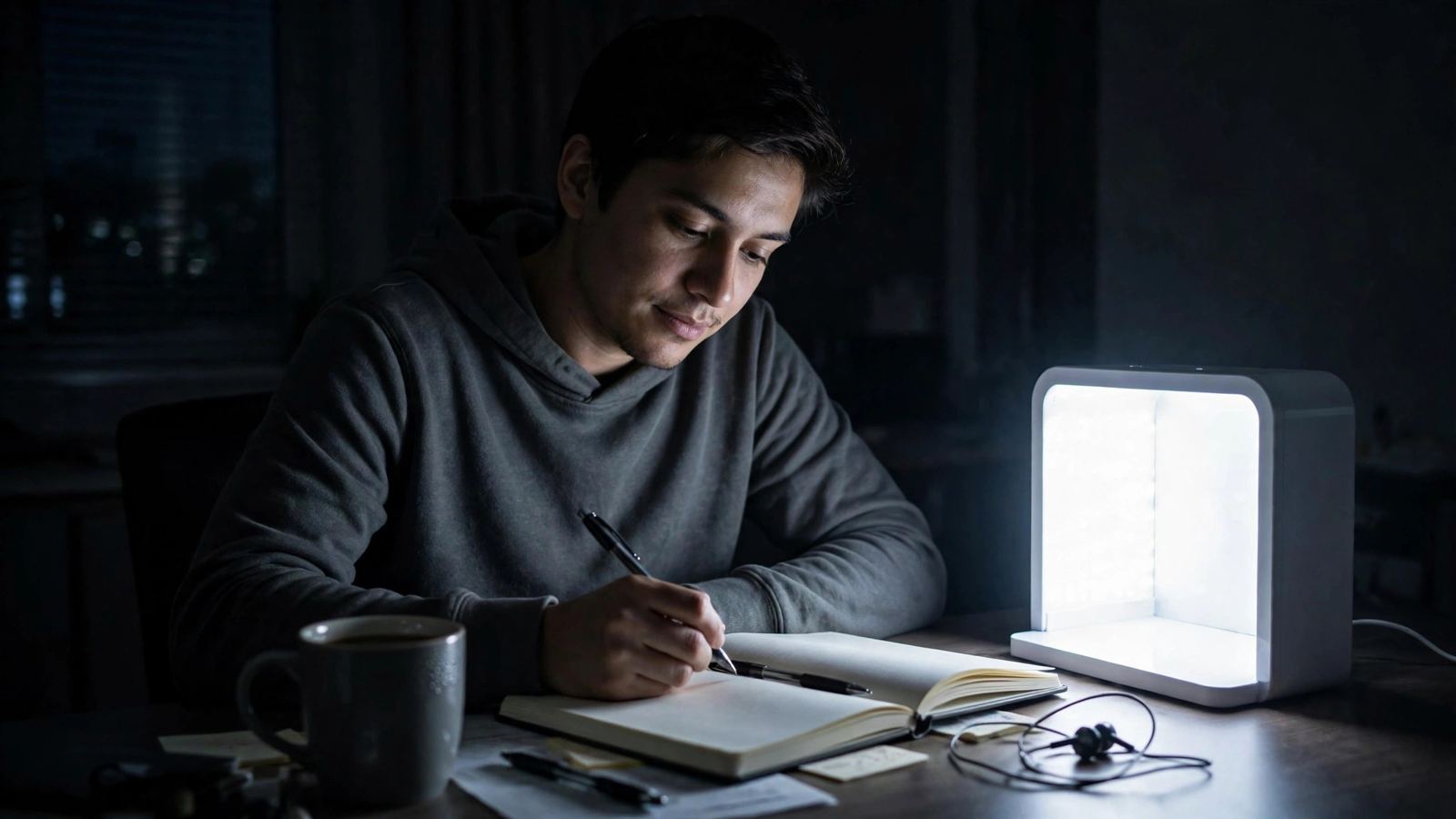
How to use a light therapy lamp for night shift comes down to three rules: sit 16 to 24 inches from a 10,000-lux lamp for 20 to 30 minutes during the first half of your shift, stop bright light in the last few hours before bed, and wear dark sunglasses on the drive home. Get those three right and the lamp works. Get the timing wrong and the same lamp will keep you wired at 8 a.m. when you need to sleep.
I learned that second part the hard way. I bought a lamp during my first year on a 7-to-7 roster, used it whenever I felt sleepy — including right before bed — and watched my day sleep get worse for two weeks. The lamp was not broken. My timing was. Once I moved the session to the start of the shift and paired it with real darkness in the morning, the 3 a.m. fog that used to flatten me by midweek started lifting. This guide is the protocol I wish someone had handed me with the box.
Why light therapy works for night shift workers
Your body clock does not care about your roster. It reads light as daytime and darkness as night, and it has done that for your entire life. A night shift asks it to flip that reading overnight, every week, with no training. That mismatch is why day sleep feels shallow even when you are exhausted.
A NIOSH analysis of more than 6,000 U.S. workers found short sleep in 61.8% of night-shift workers, versus 35.9% of day workers. The gap is not laziness or weak willpower. It is a clock sending wake-up signals at noon.
Bright light is the strongest signal you can send in the other direction. It suppresses melatonin and nudges your internal clock later, toward your night-shift schedule. The American Academy of Sleep Medicine’s 2026 clinical practice guideline on shift work disorder suggests bright light during the night shift for adults with excessive sleepiness linked to their schedule, and for circadian adaptation to nights.
One of those trials shows the dose clearly. In a study of rotating-shift nurses published in the Journal of Clinical Sleep Medicine, 46 nurses got bright light at 7,000 to 10,000 lux for at least 30 minutes during the first half of their evening or night shift, for at least 10 days over two weeks, and wore dark sunglasses after work. Their insomnia scores and anxiety and depression scores improved significantly. The control group, who wore the sunglasses but got no bright light, did not see those gains. Light early, darkness after — that pairing is the whole intervention.
How to use a light therapy lamp for night shift, step by step
1. Pick the right lamp and set the distance
You need a lamp rated at 10,000 lux at its stated sitting distance. That number matters because lux falls fast with distance. A lamp that delivers 10,000 lux at 12 inches might deliver half that at 24 inches, and then you are sitting in front of a bright desk light, not doing therapy.
Set it 16 to 24 inches from your face, slightly to one side, angled so the light reaches your eyes without you staring into it. Your eyes stay open. You read, eat, chart, or work beside it. Staring directly into the panel does not make it work faster. It just gives you a headache. If you already own a lamp, our comparison of the best light therapy lamps for shift workers covers which ones actually hold 10,000 lux at a usable distance.
2. Time the session for the first half of your shift
For a 7 p.m. to 7 a.m. shift, use the lamp between roughly 7 p.m. and 1 a.m. Twenty to thirty minutes is the standard dose. A longer session is fine on a brutal night — up to an hour — but longer is not automatically better, and it is never a substitute for getting the session early.
Breaks work well here. One 30-minute session on your first break, or two 15-minute sessions in the first half of the shift, both count. A study by Smith, Fogg and Eastman at Rush University used four 15-minute bright-light pulses across an 11 p.m. to 7 a.m. shift to reach a “compromise” shift — late enough to sleep by day, early enough to still sleep at night on days off. Pulses fit real shift work better than one long sit.
3. Stop bright light in the last few hours
This is the rule most people break. Light late in your shift pushes your clock in the wrong direction and makes daytime sleep harder, even if the early session was perfect. From about 4 a.m. on a 7-to-7 shift, dim things down. Overhead fluorescents you cannot control are one thing. Your lamp, your bright desk light, and your phone at full brightness are choices, and this is the hour to stop choosing them.
The same logic applies to caffeine, by the way. Our guide on when to stop drinking caffeine before daytime sleep puts the cutoff at least six hours before bed, and light follows the same principle: front-load the stimulant, protect the wind-down.
4. Wear dark sunglasses on the way home
Morning sun is the strongest light signal you will meet all day, and it arrives at exactly the wrong moment. Put wraparound dark sunglasses on before you step outside, and keep them on until you are in your dark bedroom. The nurses in the study above wore them, and the CDC’s NIOSH guidance for night nurses stresses the same point: sleep in darkness so dark you cannot see your hand in front of your face, because daylight triggers waking even through closed eyelids.
Sunglasses alone do not fix a bright bedroom. If your room still leaks light around the curtains, fix that first — our daytime-sleep bedroom setup guide walks through the blackout, noise, and temperature pieces in order. A lamp without a dark bedroom is like rowing with one oar.
5. Repeat it every shift, not just the hard ones
Consistency beats intensity. One heroic 90-minute session on Monday, then nothing Tuesday and Wednesday, will not move your clock. The same 20 to 30 minutes, at roughly the same point in every shift, for at least a week, is what the trials tested. I keep my lamp next to my bag so packing it is part of leaving for work.
Permanent nights vs rotating shifts: different goals
If you work permanent nights, you can aim for a full shift of your clock. Use the lamp early every shift, hold your sleep time on days off as close as you can, and let the shift deepen over two to three weeks.
If you rotate, a full shift is not realistic, and chasing it will wreck your days off. Aim for the compromise position instead: enough light to stay alert and sleep by day during your night block, but not so much that sleeping at night on your days off becomes impossible. Shorter, earlier sessions and strict morning darkness get you there.
The mistakes that made my first month worse
First, I used the lamp before bed. Bright light at 6 a.m., then bed at 8 a.m., is telling your brain to wake up two hours before you ask it to sleep. Do not do this.
Second, I sat too far away. My lamp lived on a shelf across the room, looking impressive, delivering a fraction of its rated lux to my eyes. Distance is dose. Measure it once with a tape measure and stop guessing.
Third, I skipped days off and then wondered why Monday felt like starting over. Light therapy is a schedule, not a rescue remedy. The workers who benefit most are the boring ones: same session, same time, every shift.
The honest caveat: what a lamp cannot fix
A lamp will not fix a bedroom full of daylight, a caffeine habit that runs to 6 a.m., or a roster that flips from nights to days every 48 hours. It is one tool, and it works best inside a system: light early, darkness late, and a fixed sleep window. If your roster is chaotic, expect modest gains, not a transformation — a 3 a.m. that feels survivable instead of dangerous is still a real difference — but do not buy a lamp expecting it to cancel out a bad schedule on its own.
One more firm line: if you have an eye condition, take medication that makes you sensitive to light, or live with bipolar disorder, talk to a clinician before starting light therapy. Bright light is powerful precisely because it changes brain chemistry, and that is not something to experiment with blindly.
FAQ
How long should I sit in front of a light therapy lamp on night shift? Twenty to thirty minutes at 16 to 24 inches from a 10,000-lux lamp, during the first half of your shift. That is the standard dose in the research. Longer sessions do not add much, but sessions timed near bedtime actively hurt your day sleep.
Can I use a light therapy lamp before my shift starts? Yes, and for rotating workers it is often the easiest session to keep. A 20 to 30 minute session while you eat or get ready, before you leave for work, counts as early-shift light. Just keep the rest of the protocol intact: dim light late in the shift, sunglasses home, dark bedroom.
Do I need to stare at the lamp? No. Keep your eyes open and let the light reach them from slightly to the side while you work, read, or eat. Staring into the panel adds glare and headaches, not benefit.
Will a light therapy lamp help if I only work nights occasionally? It can help with alertness on the night itself, but do not expect a real clock shift from one session. Occasional night workers get the most from a single early session plus strict morning darkness, and should skip the lamp on days off when they are sleeping at night again.
The bottom line
Use the lamp early, at the right distance, every shift — then protect your morning with sunglasses and a genuinely dark bedroom. That pairing, not the brand on the box, is what the research supports and what finally worked for me on a 7-to-7 roster. Buy the lamp you will actually sit beside, set the distance once, and let the boring repetition do the work.
General wellness information only — not medical advice. If you have an eye condition, take photosensitizing medication, or have a mood disorder, check with a clinician before starting light therapy.